
Black out and back
Minor reflections on current gloomy times and a kick in the ass to get back writing


My subscribers might not have noticed it over the last few months, when Substack was inundated with new writers and public figures leaving mainstream social media, but I remained silent, unable to write or publish. No, it is not in response to the platform’s newfound popularity, though it does produce an alert sound. I’ve mostly felt paralysed and demotivated as a result of historical circumstances. Immersed in real time in a globally streamed genocide, in its spectacularisation and numbing of a large portion of society, observing the polarisation and increasing concentration of power in the hands of a handful of psychopathic oligarchs, acknowledging the apparent dissolution of reality into a post-truth scenario manufactured and manipulated by algorithms and their owners (do algorithms have owners? Of course they do). Never in my life have I felt more useless, lost, and apathetic about the world I live in and my ability to change it. Never informing myself, writing about and criticising what I saw seemed more futile to me. I haven’t be able to find motivation and pleasure in writing since months. Well, I think I digested it now. Not that it is going better, or I see any reason for feeling better, but helas! That is the situation, and stopping to write for the few who read my lucubrations will not change it, so, hey, I am back. Whatever. There are still 350 people who subscribed to Urbiquity! Unbelievable.
Some updates on old and new projects. I decided to take some time off from my usual work activities. So, I guess we can call it a sabbatical, with the goal of writing and engaging in other creative activities, as well as finishing some (unfunded) projects that have been in the works for far too long. A book, a film, and a record on the make. And fun. I’m getting older and can’t afford to waste time on serious things and profitable jobs. In addition, I am once again involved in activist projects here in Florence, such as the rebirth of CartografiaResistente, the bottom-up critical mapping workshop I helped create 20 years ago. More details below.
Exercises in Urban Reconnaissance
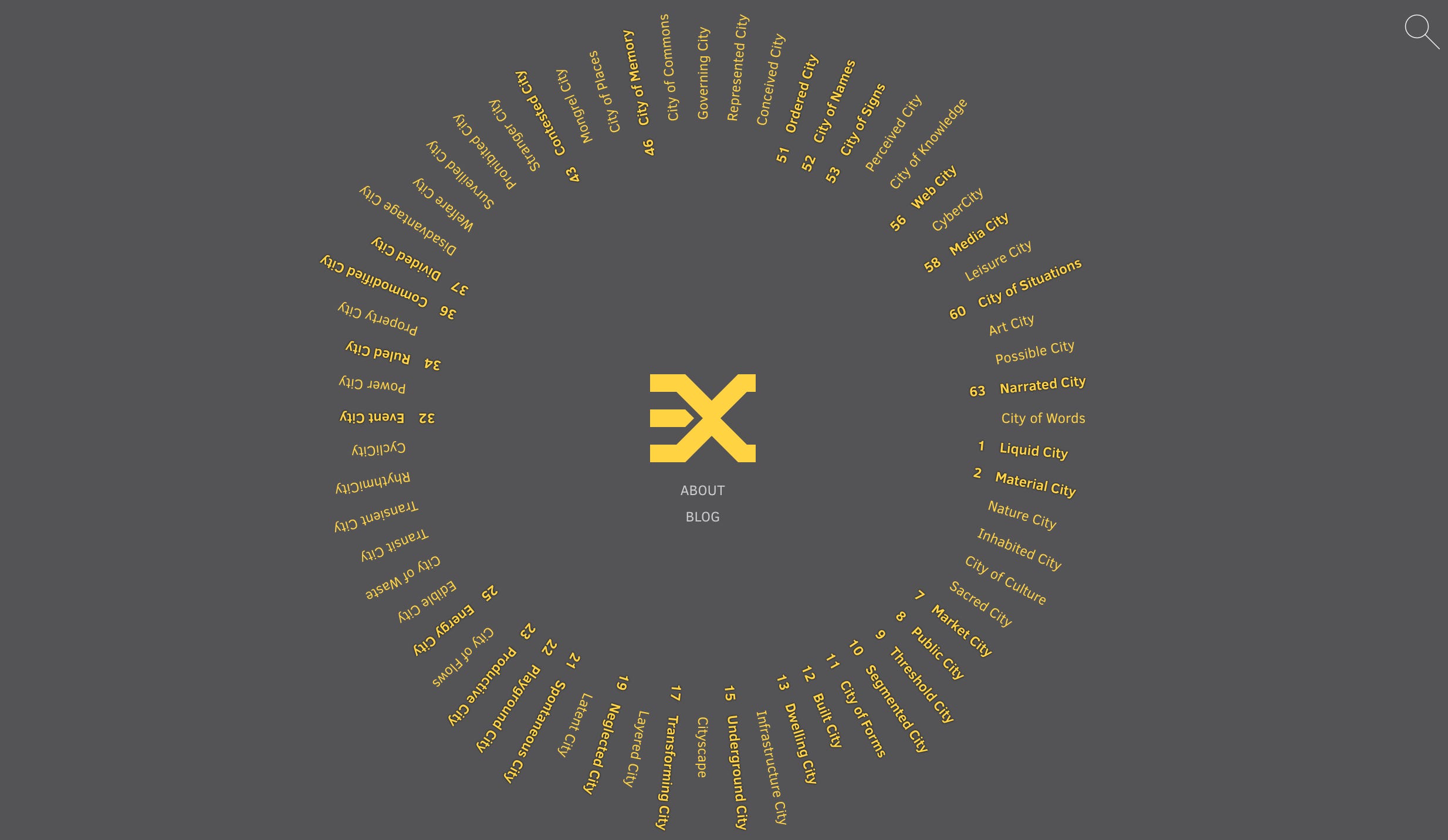
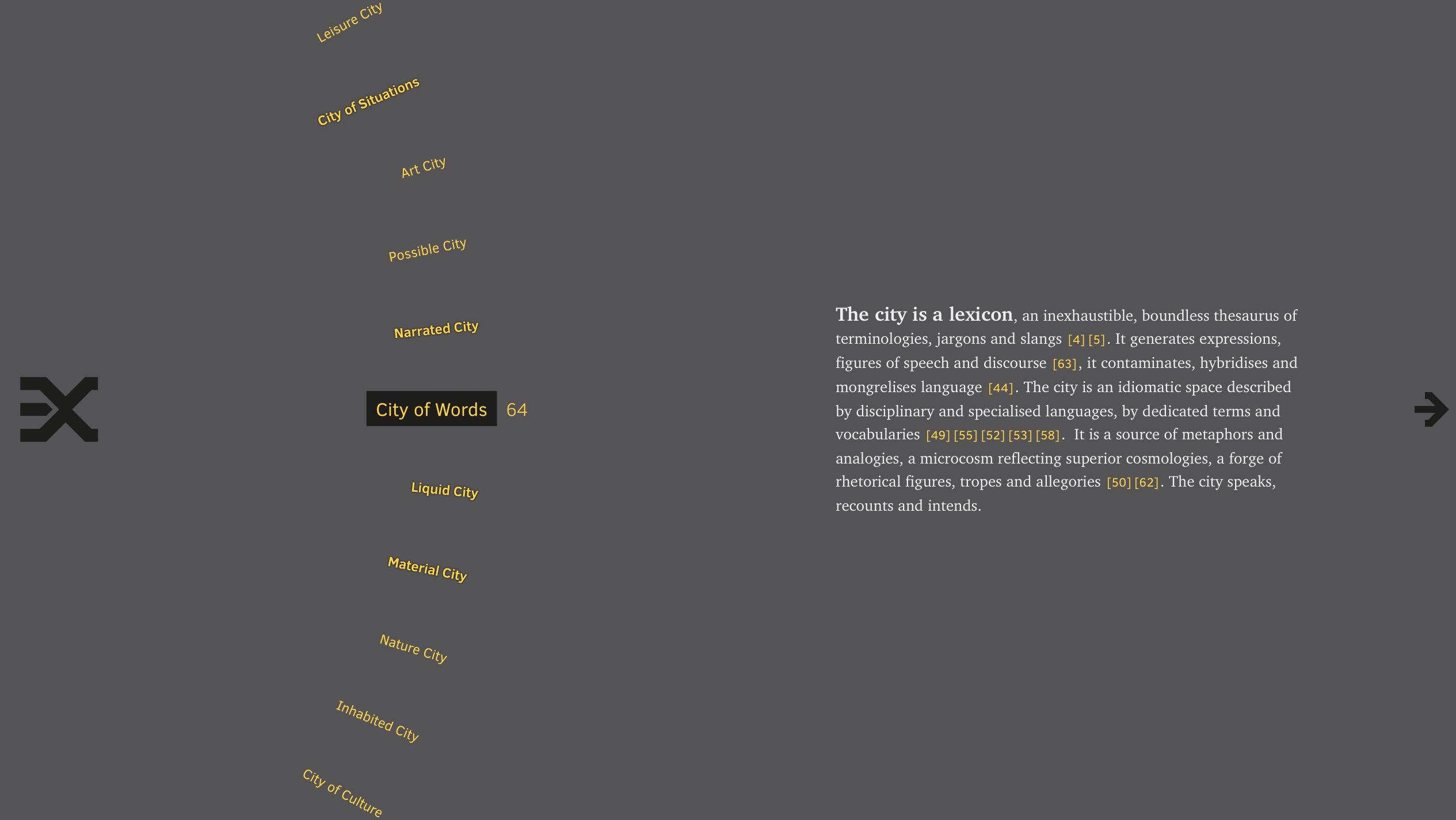
I have temporarily set aside the job of translating Urbiquità into English to work on another long-term publication project. Exercises in Urban Reconnaissance was written more than twelve years ago but only released online. It is a collection of sixty-four different definitions of the word city, completed by as many exercises of exploration. Since then, it has been employed in a variety of ways and circumstances, including exploring urban environments and establishing local initiatives, running workshops and training programs, facilitating discussions, reflecting and formulating ideas for art interventions. It has accompanied the work of both ogino:knauss and Tesserae, becoming the standard explorative method for kicking off space-related initiatives of all kinds. I’ve been asked several times why it is not published as a printed book or when I intend to do it. I am pleased to inform you that I have finally taken the first step toward completing this task, beginning to re-edit the text in light of so many years of use and feedback, as well as working on the Italian translation. I am now at an advanced stage, hoping to have both versions available by the beginning of the new year and looking for publishers in both the Italian and Anglophone markets. The web platform will also be updated, including multilingual versions and other enhancements like essential mobile navigation and a bibliography.
Here few brief excerpts from the book’s afterword in which I also relate to Urbiquity’s arguments.
Sixty-four definitions of the word city, each derived from a different disciplinary or thematic perspective. Each of these definitions is correct and arguable in itself. However, none is complete, exhaustive or sufficient. Each offers a foothold, a pretext, a gateway to a complex and elusive concept and its semantic universe, but on its own it cannot exhaust the multiplicity of aspects and languages necessary to understand the object in question. True and complex in itself, each individual definition is also partial, unable to explain its object completely. While each provides only a possible starting point for exploration, a sort of magnifying glass to highlight a specific factor from which to begin a survey, they are interconnected, generating a comprehensive hypertext, a universe of words surrounding the urban field.
Exercises in Urban Reconnaissance is a complicated attempt to answer a basic question: what is a city? The term city is one whose meaning everybody immediately understands, but which is difficult to define exhaustively and consensually. Rather than representing an object, it indicates a semantic, political and philosophical field. This term is adopted in this context as a catalyst and provocation rather than as an object of research in itself: the essential irreducibility of the complexities it implies and connects is in fact the only possible focus of the project. Exercises in Urban Reconnaissance therefore proposes itself as a ‘device for disentangling urban complexities’. Rather than defining the city in itself, it is the complexity of its nature to constitute the actual object of the analysis.
(…)
Nowadays, the city is everywhere. Not so much because urbanised and built-up areas have multiplied disproportionately (although this is also true), but above all because it now connects and traverses places and bodies, languages and economies indiscriminately, without any significant distinctions between spheres, levels and jurisdictions. There is no longer any rural or wild place from which one can completely escape, disconnect, or not participate in urban production. The final stage of global urbanisation manifests itself as a process of evaporation that has infused the entire planetary sphere with a nebulous, pervasive and uncontrollable urban condition. Everything that once gave the city reason to exist as a discrete and autonomous entity is now accessible everywhere and interconnected with an economy of flows that recognises no boundaries, administrative limits or cultural specificities. However, this has not diminished the centrality and impact of cities, but has immensely multiplied the complexity, elusiveness and uncomputability of the urban.
This renewed techno-social condition, exemplified in the concept of urbiquity, requires the development of new and multiple tools for exploring the territory and its increased dimensions. New instruments are needed by the flâneur, the psychogeographer, the urban explorer and the digital nomad of the twenty-first century to orient themselves (and disorient, if necessary) in the emerging planetary geography. A hybrid epistemological apparatus is necessary to address the domain of the hyper. Hypertext, hyperconnection, hyperstimulation, hyperreality. These are just a few of the many semantic compounds generated by the most popular suffix of our era, a suffix in which the original dimensional meaning acquires the extended sense of going beyond, overwhelming, crossing paradigmatic thresholds. In this sense, we are witnessing the crossing of the threshold towards the hyperurban, immersed in a condition of paroxysmal and irrefutable connection.
It is in this scenario, between abstract reflections and observations surfaced in the daily practice of exploring the contemporary city, that the Urban Reconnaissance Exercises were born.
(…)
The term reconnaissance is commonly associated with military practice aimed at inspecting and understanding a territory in order to dominate it. In our project, while acknowledging its strategic meaning, we refer above all to the original etymology of the term from the Latin recognoscere: to know again. An etymology that reflects how understanding a place is essentially based on resonance and recognition of configurations, rhythms and recurrences that are intrinsically familiar to our bodies. It is not just a matter of deducing knowledge of the city from the external acquisition of data within a given framework of codified knowledge, but also and above all an inductive process that recognises the relationships that are formed and renewed between bodies and territories in constant flux.
Urbiquity: the film.
My last book’s central idea is that what was once perceived as two distinct domains, cinema and city, have gradually melted over the last century or so into a hybrid condition in which spatial and image production processes have merged into the cinematic mode of production. Cinema, which was once confined to dedicated distribution circuits such as movie theaters and broadcast television, has flooded into society and space at large, fostering a new condition in which images are nebulised and distributed fluidly through personal devices, significantly altering how we experience urban life. I’ve written a dense volume of more than 300 pages to investigate this concept from various angles and through the exploration of three specific urban settings: Florence, Berlin, and New York. The next logical step is to use the cinematic image itself to further investigate the topic. We discussed how to make the most of this opportunity with fellow director and cinematographer Manuela Conti, and the plan is not to make a film version of the book, but rather to expand its arguments through a global exploration of urban space, attempting to capture such a hegemony of the image through moving images. We will thus begin with the three cities examined in the book but broaden our journey through the continuum created by the urbiquitarian condition in the planetary representation sphere. We are also planning to stage some conversations about the topic together with some people we think may have interesting views to bring to the discussion. Some like Christian Schmid and Franco Berardi already expressed their willingness to join in the conversation. I plan to employ this newsletter to share the progress of this new endeavour and excepts from these conversations.
Cinema and the City
Meanwhile, some of the key arguments of Urbiquity have been condensed in a book chapter I wrote for Cinema and the City in the Era of Planetary Urbanisation, edited by Nitin Bathla, Silvia Cipelletti, Markus Lähteenmäki and Klearjos Papanicolaou, in course of publication by Jovis. Preorder is already available on the publisher’s website.
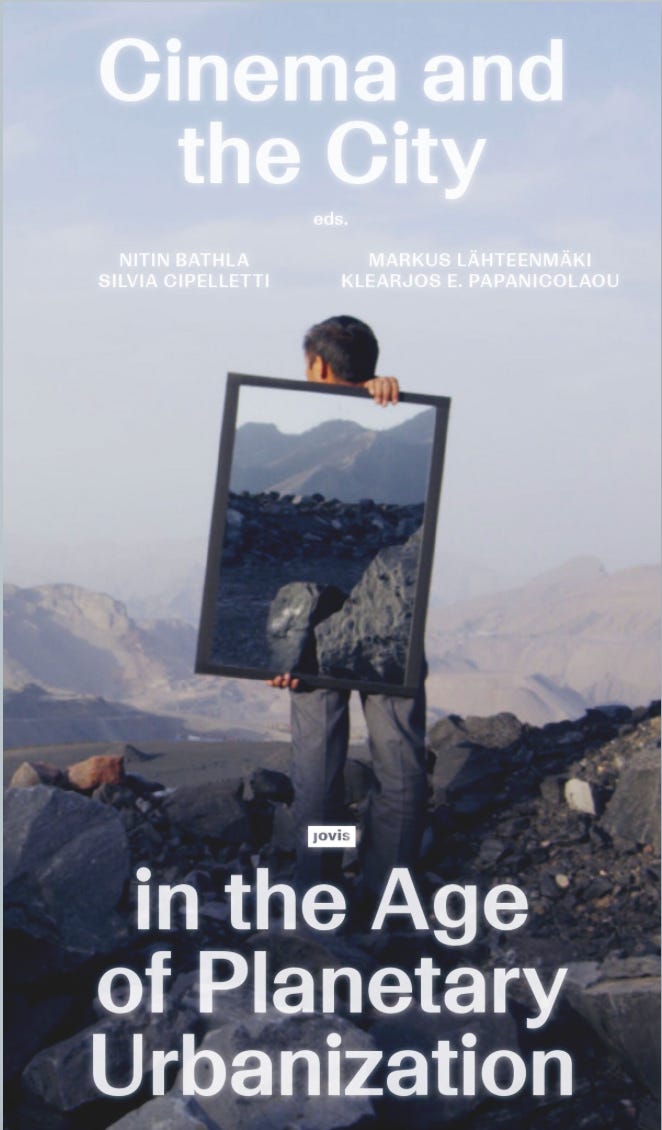
Amid deepening ecological and democratic crises, urban theory is changing fundamentally. Film and cinema—media historically intertwined with the city—have likewise undergone a profound transformation in its modes of representation and visual culture since the late 1980s. Today, filmmakers, photographers, and radical artists investigate the distant landscapes and territories of extended urbanization in all its forms. Films like Behemoth (Zhao Liang, 2015), Homo Urbanus (Ila Bêka & Louise Lemoine, 2017), and Leviathan (Lucien Castaing-Taylor & Véréna Paravel, 2012) exemplify this genre. But how do cinema and the city mutually shape each other? This book stages an encounter between film and the theory of planetary urbanization by deploying the notion of the Sensoriums of Planetary Urbanization. It offers a deep analysis of the multifaceted experiences of urban life—within and beyond the city.
CartografiaResistente 25
In 2005, CartografiaResistente took shape, a grassroots mapping workshop in Florence. Avoiding identity-based impulses and political co-optation, CR’s immediate goal was to produce a living atlas of the city’s social movements and of areas of public intensity, conflict and aggregation. Without affiliations or judgements of merit, the idea was to build shared knowledge and reconnect emerging issues, criticalities and practices of resistance by assembling a shared navigation tool for the “other” city. If cartography is the imperial tool par excellence, CR aimed to overturn this perspective, abandoning the bird’s-eye view, photogrammetric view of the territory and its normative and prescriptive purpose, in order to recount the evolution of the psycho-political and material landscape of Florence from the ground, from insurgent practices and from personal perspectives. The workshop adopted a hybrid methodology, combining empirical data collection with a situationist psycho-geographical attitude of losing oneself in the territory. On the one hand, a practice of drifting across liminal areas, stemming from specious and convoluted procedures designed to derail the established paths of urban productivity; on the other, the construction of a database/digital atlas, at the time an avant-garde attempt to build a collaborative online platform prior to the advent of Google Maps, based on wiki technology and the Indymedia model. The CR experiment in terms of activities on the field lasted a couple of years, followed by few participations to exhibitions to present its findings, and a few publications. 1
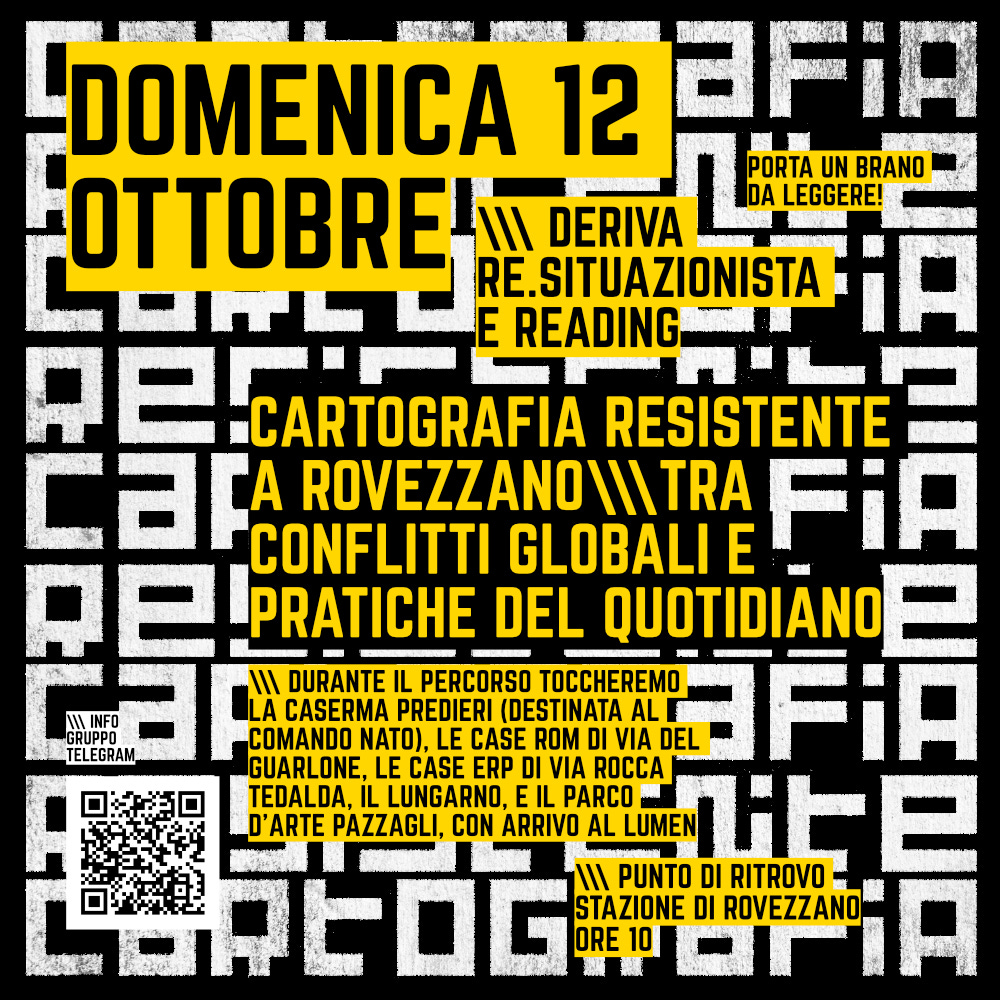
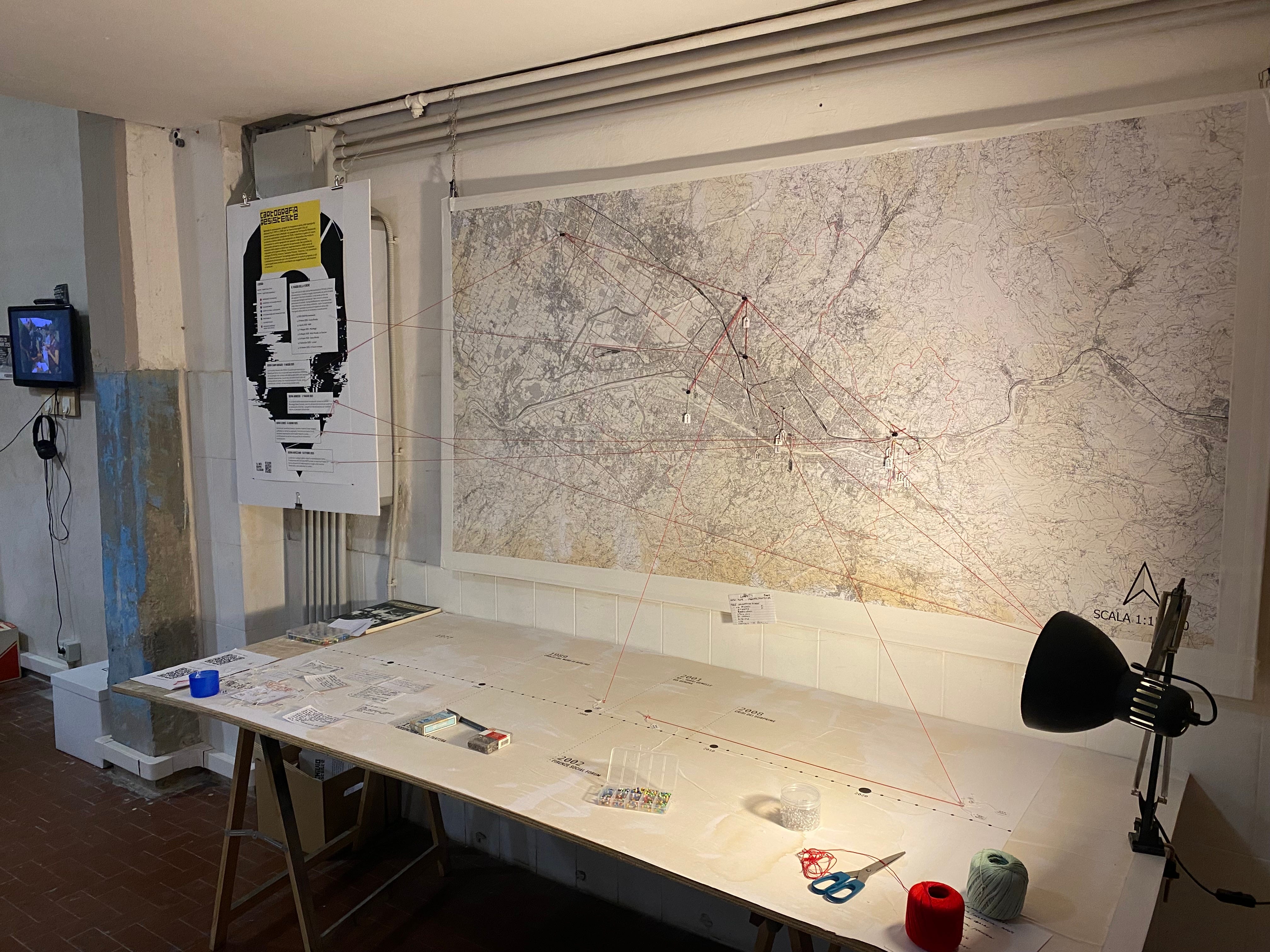
In 2025 CR has set off again, or rather, on an expedition. Keepers of a fleeting but sharp memory and effective, albeit rusty, tools, the laboratory has been reactivated with the aim of re-establishing connections, both horizontally/spatially – between the realities of the troubled territory and the resistance initiatives – and vertically/temporally – re-establishing the interrupted chain of transmission of antagonistic and resistant practices between generations. Compared to the naive technological optimism of twenty years ago, while not denying the need to use digital tools to archive and communicate our findings, we have decided to put the presence on site, the use of our hands and material techniques back at the centre of our practice. The new atlas takes shape on paper, with pins, scissors, threads, glue and in convivial gatherings of bodies, the result of laborious drifts through the restless spaces of the city and participation in demonstrations, assemblies and events.
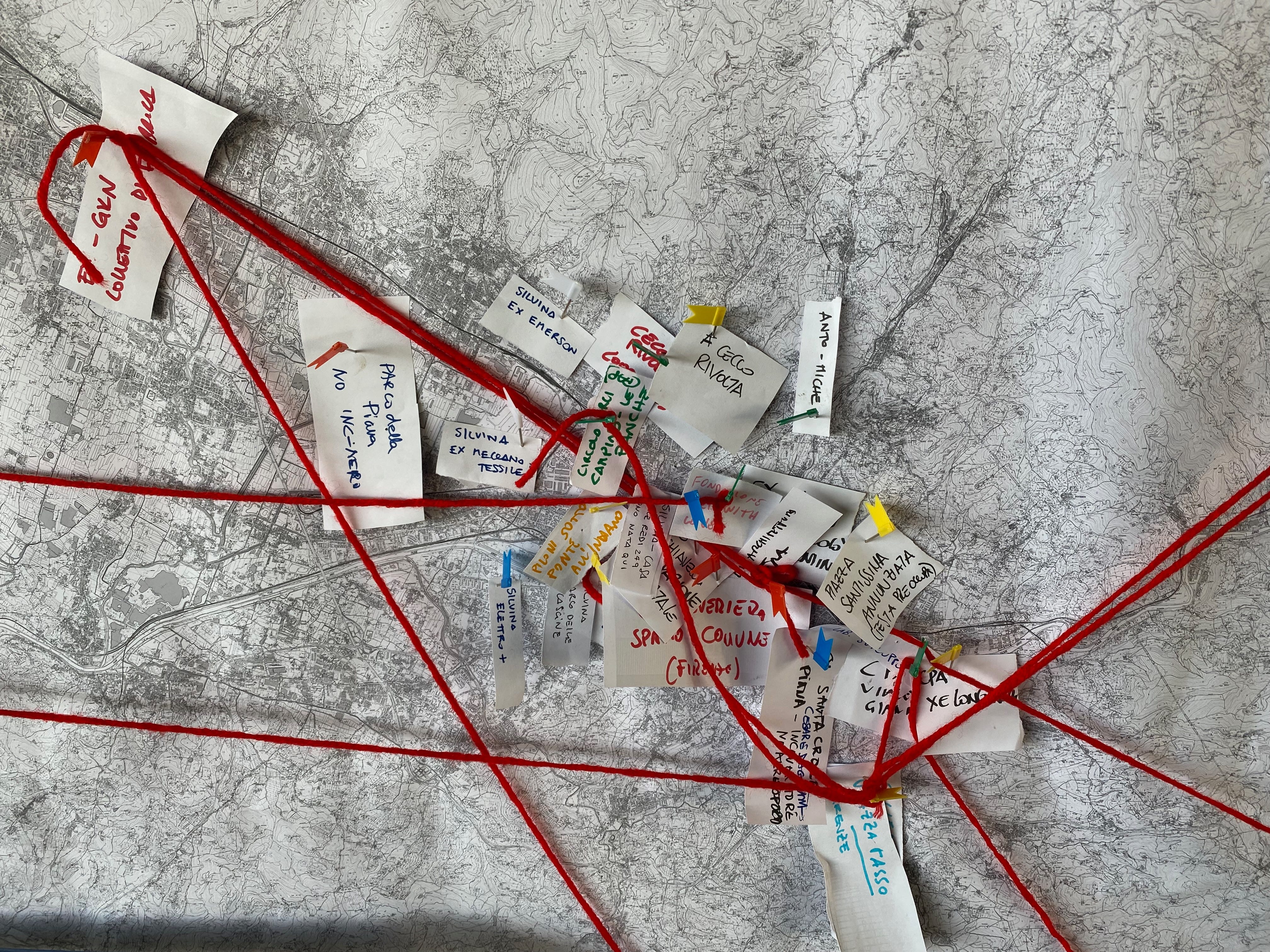
It is a way of reclaiming control over our production and demanding the creation of autonomous zones free from the sprawling reach of technological semiocapitalism, which has assumed total and unsustainable hegemony. The mapping process that we began at the end of the first drift of the new cycle, around GKN factory occupied by its workers in Campi Bisenzio, and continued in critical areas such as Santa Croce, Rovezzano, and the new developments affecting Porta al Prato and the Cascine, is based on the reconstruction of personal trajectories: both from an individual perspective, collecting biographical paths through the encounter and clash with the body of Florence by the participants and the people met along the way; and from a collective perspective, reconstructing paths developed in groups, such as the drifts experienced together, but also events, occupations and demonstrations that have marked the history and psychogeography of the city and beyond. The results of the investigation process are initially recorded on two media: a map of the territory where significant experiences, both present and past, are located; and a timeline, which draws an intertwined chronology based on the biographical data of the contributors. The threads connecting places and moments draw a complex and chaotic chrono-geography from which crucial moments and places, collective memories and hot spots of transformation emerge. We are currently at work on two parallel publication projects: ArchivioResistente is a digital archive of memories of social movements in Florence, and Derivati, an old style zine collecting elaborations from the practice of urban derives of the collective.
Lorenzo Tripodi (2008) “Cartografia Resistente: an Experience of Participatory Mapping Implementing Open Source Technology” in Eckardt et al. (eds.), MEDIACITY: Situations, Practices and Encounters. Berlin: Frank & Timme .
Thank you! Very interested in your experience on counter- mapping, as well as sharing ideas on how developing archival projects able to avoid the seduction of mainstream platforms to make knowledge accessible. Ironically, the power of personal biography is the same mechanism that lies at the basis of the social media platform model that transforms the collective memory in an extractive resource!